Umur Tugay Yücel
Political Scientist – Foreign Policy Expert
Turkey’s geographical position, security priorities, and international operational commitments make military air transportation one of the most critical components of the country’s defense architecture. For this reason, the C-130 Hercules fleet, which has formed the backbone of the Turkish Air Force for many years, has undertaken important responsibilities across a wide range of missions, from humanitarian assistance and cross-border operations to NATO activities and disaster management. However, the fundamental design philosophy underlying this platform dates back to the 1950s. Most of the aircraft currently in service in Turkey represent production from the 1960s and 1970s. Although modernization programs have updated these aircraft to a certain extent, the aging of the fleet, changing operational requirements, and the new realities brought about by the modern battlespace make Turkey’s move toward a more technologically advanced military transport aircraft strategically meaningful.
Aging American Aircraft in Need of Replacement: C-130 Hercules
Although the C-130 family has been known for many years for its durability and extensive logistical network, it remains limited in terms of parameters required today, such as speed, digitalization, low operating costs, and protection against modern threats. Structural fatigue, increasing maintenance times, and the inevitably rising operating costs of older-generation platforms reinforce Turkey’s need to move toward a younger fleet. Therefore, it no longer appears possible to keep the C-130 fleet operating effectively for an extended period through modernization alone. Although the C-130 remains one of the successful military aircraft, it is increasingly becoming an older-generation platform in the face of a rapidly changing combat environment, growing logistical demands, and modern technologies. For countries seeking to establish a new fleet, it is increasingly far from being the most optimal choice.
Today, as advanced electronic warfare protection and digital mission systems have become essential, the C-130 is unfortunately inadequate when it comes to the full integration of these technologies. Moreover, dependence on a U.S.-produced platform may create political and technical restrictions in the areas of spare parts and modernization. Turkey has already experienced this in connection with the F-35 program and CAATSA sanctions.
Brazil as an Emerging Power in Next-Generation Military Transport: Embraer C-390 Millennium
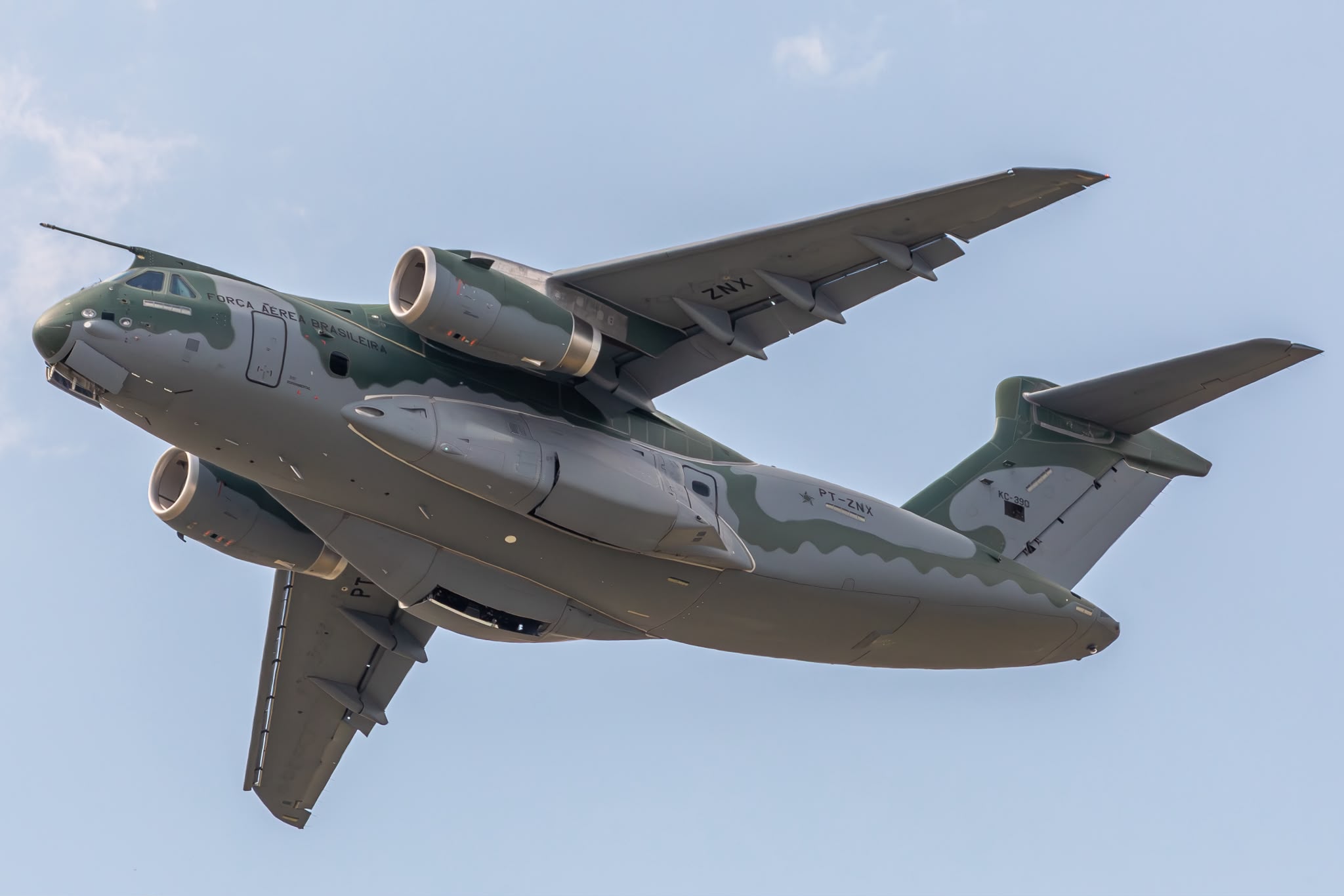
The C-390 Millennium, developed by Brazil’s world-renowned aerospace company Embraer, is a platform that has rapidly emerged among modern military transport aircraft thanks to its high capabilities and innovative engineering. Unlike the traditional aircraft designs that dominated the military transport market for many years, the C-390 was built from the ground up with an entirely new approach, taking into account the operational requirements of the 21st century. In this respect, it is regarded as more than simply a transport aircraft and is considered a multi-purpose operational system, with many countries viewing it as one of the logistics solutions of the future.
One of the C-390’s most striking features is its high cruising speed, achieved through modern turbofan engines that deliver exceptional performance for its class. Its ability to reach speeds of Mach 0.8 provides a significant advantage in scenarios where time is critical, ranging from emergency humanitarian assistance missions and rapid deployment operations to the transportation of critical supplies and medical evacuation.
In addition to its speed, the aircraft also stands out for its superior efficiency in carrying cargo. With a payload capacity of approximately 26 tons, a spacious cargo compartment, and full compatibility with NATO pallet systems, the C-390 can fulfill a much broader range of missions than would normally be expected from a medium-class transport aircraft. Armored vehicles, heavy logistical equipment, ammunition pallets, helicopter components, and large-volume humanitarian aid packages can all be accommodated within the aircraft’s carrying capacity. This flexibility makes the C-390 an effective multi-purpose solution not only for military operations but also for disaster management and civilian support missions.
Another major advantage of the C-390 is its modern avionics architecture and advanced flight-control system. Fly-by-wire technology reduces the pilot’s workload while significantly enhancing flight safety and maneuverability. Its simplified cockpit design, high level of automation, and advanced sensor integration enable the aircraft to deliver reliable performance even in complex missions. At the same time, the C-390 has a high operational success rate under low-visibility conditions and on challenging runways requiring precision landings.
Embraer’s engineering approach has designed the aircraft not merely as a powerful transport platform but as a multi-role mission aircraft. Since the C-390 has both aerial refueling and air-to-air refueling capabilities, it provides an operational capacity that can act as a force multiplier for air forces. In addition, the aircraft can be used as a transport aircraft, tanker, search-and-rescue platform, medical evacuation aircraft, and for airdrop missions. This versatility enables more efficient use of defense budgets and enhances cost-effectiveness. The aircraft’s ease of maintenance, durable airframe structure, and low life-cycle cost are also notable features. Digital maintenance records, systems capable of detecting faults in advance, and modern production techniques make the C-390 an extremely economical option to operate in the long term. Embraer’s extensive experience in the commercial aircraft sector also provides the aircraft with significant advantages in terms of logistical support and global supply-chain management.
The C-390 Millennium’s rapidly growing international market interest demonstrates that the platform’s capabilities are effective not only on paper but also in practice. The fact that NATO member states have also selected the platform is an important indicator of the C-390’s technological maturity and compatibility with alliance standards. Tested in different climates and proven under various operational conditions, the aircraft’s increasingly expanding global user base indicates that it is likely to assume a greater role in the strategic airlift market in the future.
The Ideal Alternative for Turkey: C-390
The Embraer C-390 Millennium not only breaks traditional patterns in the military transport sector but also combines a modern design philosophy with high performance. Thanks to its advanced technological infrastructure, it is a platform capable of addressing the operational requirements of the future already today.
The high cruising speed achieved by the C-390’s turbofan engines provides Turkey with a significant advantage by enabling a faster response in humanitarian assistance missions and operations requiring an immediate reaction. In addition, its larger internal cargo volume and approximately 26-ton payload capacity make it possible to transport larger and heavier loads than the existing C-130 variants. This creates a significant increase in efficiency in areas such as armored vehicle transportation, the transport of special forces equipment, airborne delivery, and large-scale humanitarian assistance operations.
The ease of maintenance and high sortie rate provided by a next-generation platform could be a critical supporting factor within Turkey’s intense operational tempo. Digital maintenance records and built-in diagnostic systems accelerate fault detection and intervention processes, reducing the amount of time aircraft remain on the ground. Considering the increasingly heavy maintenance burden of an aging C-130 fleet, this capability is one of the key factors that distinguishes the C-390 operationally.
The C-390’s ability to carry 84 military personnel and its development in full compliance with NATO standards are also significant advantages for Turkey. This would provide Turkey with a broader range of capabilities in NATO missions. Today, NATO members such as Portugal, the Netherlands, Hungary, the Czech Republic, Slovakia, and Sweden operate the Brazilian-made C-390 military transport aircraft. This also enables these countries to further expand joint training, maintenance, and procurement networks. While increasing Turkey’s operational interoperability, this situation could also provide long-term advantages in terms of cost sharing. In Asia, South Korea, as well as Uzbekistan within the Organization of Turkic States, are among the countries that have acquired the C-390.
A New Axis in Defense Industry Cooperation: The Turkey–Brazil Line
Beyond these technical and operational factors, another dimension of the C-390 that stands out for Ankara is its potential for defense industry cooperation. The defense industry relations that have developed between Turkey and Brazil in recent years could bring options such as joint production, technology sharing, or local maintenance integration onto the agenda during the procurement process for the C-390. Turkey’s advanced aerospace infrastructure and engineering capabilities provide more than sufficient foundations for such cooperation. In addition, Brazil’s more flexible export-control policies compared with those of the United States would create a strategic area of choice for Ankara, which places importance on political independence within its supply chain.
The true strategic value of the C-390 lies in its potential to elevate Turkey-Brazil defense industry relations to a new level. The acquisition of the aircraft could evolve into technology sharing, joint production, maintenance and logistics centers, as well as joint export projects targeting third countries. The inclusion of Turkish companies such as TAI, ASELSAN, HAVELSAN, and TEI in the C-390 ecosystem could take the project beyond a simple procurement agreement.
This cooperation would also add a defense dimension to Turkey’s opening toward Latin America. Turkey, as one of Europe’s important defense and aerospace actors, and Brazil, as one of Latin America’s major defense and aerospace powers, could establish a new defense industry network on both sides of the Atlantic. From a geopolitical perspective, within the framework of Turkey’s multidimensional foreign policy approach, establishing links with alternative procurement partners while balancing its relations with the United States would increase Turkey’s room for maneuver in the defense sector. Choosing the C-390 would therefore go beyond being a technical modernization decision and would also be consistent with Turkey’s strategy of developing a diversified procurement architecture within the global balance of power.
Turkey’s move from its C-130 Hercules fleet toward a next-generation military transport platform such as the C-390 Millennium cannot be explained solely by the aging of the fleet. It can be regarded as a multidimensional decision with strategic, technical, economic, and geopolitical dimensions. For this reason, the C-390 stands out as a platform capable of taking Turkey’s military air transportation capabilities to a new level, adapting to the modern threat environment, and aligning with Turkey’s defense industry objectives.
Next-Generation Military Transport Aircraft: A Strategic Necessity for Turkey
Turkey’s military air transportation capacity has become more strategically important than ever due to the country’s geopolitical position and growing responsibilities. Aircraft such as the C-130 and CN-235, which have been operated by the Turkish Air Force for many years, are aging, while their maintenance burden has increased and they have fallen behind the performance standards required by the modern combat environment. Expanding mission areas, including cross-border operations, NATO missions, missions conducted in Africa and the Middle East, evacuation operations, and humanitarian assistance flights, make next-generation transport aircraft with higher speeds, greater payload capacity, and more advanced avionics increasingly necessary.
Turkey also has a significant need for high-capacity and fast aircraft from the perspective of disaster management. More modern aircraft are required for the rapid deployment of equipment, personnel, and relief supplies during critical situations such as earthquakes, wildfires, and floods. As electronic warfare, GPS jamming, and radar threats increase in today’s airspace, older platforms do not possess sufficient sensors, protection systems, or digital mission-management capabilities to cope with this complex environment. These modern aircraft, which are compatible with NATO standards, would enable Turkey to perform its responsibilities within the alliance more effectively and thereby increase its strategic value. A strong air logistics network is essential for maintaining effectiveness in regions such as the Caucasus, the Middle East, the Eastern Mediterranean, and North Africa, where regional competition is intensifying. Next-generation military transport aircraft offer more than simply an aircraft; together with simulators, digital mission-planning systems, and integrated maintenance infrastructure, they provide a modern operational ecosystem.
For all these reasons, the transition to next-generation military transport aircraft is not a matter of choice for Ankara. It is a necessary investment from military, economic, and geopolitical perspectives. This transformation will undoubtedly provide Turkey with faster, safer, lower-cost, and broader operational capabilities, significantly strengthening the country’s strategic power in the long term. At the same time, the fact that it would both reduce and diversify Turkey’s dependence on the United States and Europe would enhance its strategic autonomy. Indeed, the relationship to be established with Brazil, the giant of Latin America, would lay the foundations for transforming Turkish-Latin cooperation into a deeper and more institutionalized structure. Thus, an important threshold would be crossed in terms of the role that these two emerging powers can play in a multipolar and multicivilizational world.